How does it perform?
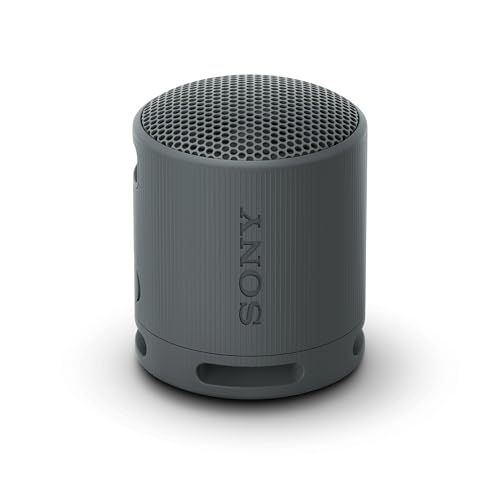
The Sony SRS-XB100 wins on portability and battery life while making significant acoustic compromises. The claimed16-hour battery is supported by multiple experts, and if you keep your volume level low, you can push it close to 18 hours. One reviewer even went nearly five days of heavy on-and-off use before hitting low battery. Bluetooth 5.3 achieved 131 feet of line-of-sight range with Google Fast Pair for quick Android pairing. But the sound quality reveals fundamental limitations. Consumer Reports noted “lower range overall sound quality” with “sonic shortcomings,” while multiple reviewers documented surface-dependent audio that shifts significantly with speaker placement and angle. The single upward-facing full-range driver produces surprisingly robust bass for the size but muddy treble, absent deep bass, and compression at maximum volume.
What’s it do best?
The SRS-XB100 excels at true go-anywhere portability without sacrificing durability. At 267g (lighter than most smartphones) it disappears into jacket pockets or bag straps via the included multiway strap. That IP67 rating survived real-world testing, making it genuinely adventure-ready for showers, beaches, and outdoor use. Couple with with its 17-hour battery life and week-long trips with daily use between charges is completely achievable.
Audio Performance Quality
Frequency Response
Wide frequency coverage determines how completely a speaker reproduces music.
Frequency Notes: Bass present down to 60Hz effectively, treble muddy above 12kHz in upright position
The XB100 delivers more bass than its size suggests; multiple reviewers noted the bass presence impressed for such a compact speaker. But deep sub-bass remains absent, and the treble suffers from the upward-facing driver configuration, creating muddy, sizzly highs that lack refinement. After a break-in period, the sound became “surprisingly fresh and clear,” but keep in mind that’s in the context of a sub-5cm driver.
Total Harmonic Distortion (THD)
Distortion measurements reveal how cleanly a speaker reproduces sound at various volumes.
Moderate Volume (50%): Clean reproduction, no audible distortion
High Volume (75-80%+): Some compression but remains listenable
Maximum Volume: Noticeable compression, bass rolls off
Testing at 50% volume produced clean playback with no audible distortion across multiple genres. Push to 75% and the speaker starts showing its limits—compression becomes evident and bass impact diminishes. Maximum volume remains usable but lacks the punch of moderate levels. The speaker simply wasn’t designed for loud outdoor gatherings.
Connectivity Performance
Bluetooth Range
Wireless connectivity determines practical mobility and reliability.
Operating Range: 82 – 100 feet through walls, 131 feet with line of sight
The line-of-sight range exceeds most portable speakers in this class. Real-world testing confirmed reliable connections across typical usage distances. Google Fast Pair delivered the promised instant pairing experience on Android devices. Multiple reviewers praised the “easy pairing” and “seamless integration” for setup and daily use.
Audio Latency and Codec Support
Time delay and compression affect video synchronization and audio quality.
Audio Latency: Low latency for video content
Codec Support: AAC (Apple devices), SBC (Android devices)
Notable Omission: No aptX support
Latency stayed low enough for video watching without noticeable lip-sync issues. The codec situation is basic but appropriate for the speaker’s limitations. One reviewer even noted aptX “would almost be wasteful luxury” given the constraints of a sub-5cm full-range driver. AAC support benefits Apple users, while Android users get standard SBC.
Power Management and Battery Performance
Battery Life
Battery life is just how long you’ve got before the speaker has to be plugged in once again.
Real-World Testing (50% volume): 17.5 hours
Maximum Volume Life: 2.5 hours
The 16-hour battery claim holds up remarkably well in real-world testing. TechRadar’s methodical measurement at 50% volume estimated about 17.5 hours total runtime, and Tom’s Guide confirmed the figure with daily use requiring charging just once per week. Push the speaker to maximum volume though, and expect just 2.5 hours. Dramatic? Yes. Typical? For small speakers under stress, yes.
Charging Performance
Recharge duration affects device readiness and convenience.
Charging Time (0-100%): 4.0-4.5 hours via USB-C
Fast Charging: Not supported
The 4-4.5 hour charging time disappointed multiple reviewers. Plan ahead—running it dead means waiting until the next day for full power. The basic orange blinking indicator provides minimal information though, which is a major letdown. If you want precise battery percentages, you’ll need your phone connected to it.
Build Quality and Durability
Water and Dust Resistance
Environmental protection determines outdoor suitability.
IP Rating: IP67 (dustproof, waterproof to 1m for 30 minutes)
The IP67 rating passed real-world validation across multiple reviewers’ testing. The speaker handled beach trips, showers, and outdoor exposure without issues. One reviewer specifically noted it as “adventure-ready” based on durability testing. The rating makes it legitimately suitable for wet and dusty environments that would damage lesser speakers.
Setup and Usability
Software Integration
Everything that’s even a little smart has an app or software, and if that software is terrible, odds are good using the gadget is going to follow suit.
App: Sony Music Center (iOS and Android)
App Functionality: Battery level display, firmware updates only
Missing Features: No EQ controls, no bass/treble adjustments, no meaningful customization
The Sony Music Center app earned universal criticism for its minimal functionality. It displays battery percentage and delivers firmware updates. That’s it. The app shows installed music apps and streaming services but can’t control them beyond volume. No EQ settings, no sound customization, no useful features. When competitors like the JBL Go 4 offer app-based EQ customization, that’s a hard pill to swallow.
Control Interface Design
You’ve got to interface with the speaker to get it to do anything if you aren’t using your phone, and that means playing with buttons. Bad buttons mean you’ll have a bad time.
Button Quality: Well-sized, tactile, intuitive operation
The physical button design earned praise for its chunky, easy-to-press design. Power, play/pause, and volume controls work intuitively without requiring app interaction. Long-pressing the play/pause button activates phone voice assistants, though the speaker itself lacks built-in assistant support.
Voice Call Performance
Some speakers like to pull double-duty, giving you the option to have a conference call in between jams. But if the microphone is bad, you’re never going to bother.
Call Quality: “Clear” pickup, testers noted good sound quality
Voice Assistant Performance: Siri and Google Assistant responded accurately
Voice call performance exceeded expectations for a budget ultra-portable. Recipients reported clear audio quality during phone calls and voice assistant recognition worked accurately.
Last modified: December 17, 2025
About the Author: Chris Peters