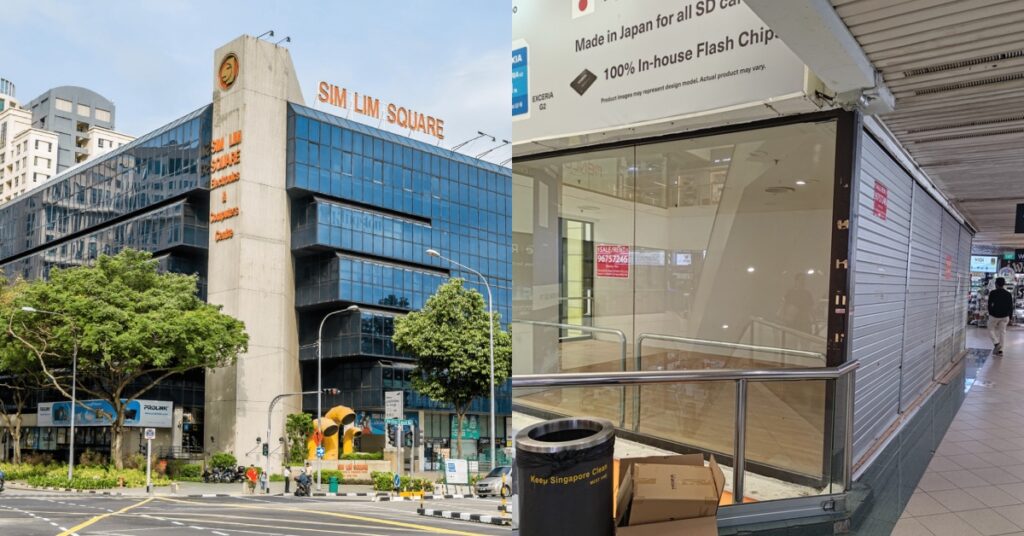
Walk into Sim Lim Square today, and a dose of nostalgia hits you instantly: fluorescent lights hum overhead, narrow corridors snake past countless small shops, rows of monitors, cables, and gadgets, and of course, that unmistakable smell of an old mall.
For many Singaporeans who grew up in the 1990s and 2000s, this six‑storey building near Rochor MRT was the place to buy PC parts, build your own rig, or find hard‑to‑get tech components.
But that scene now shows clear signs of decline. Shuttered units are aplenty, footfall is sparse, and Sim Lim’s top floor has become known for its nighttime activities, leaving even longtime tenants reconsidering their place in a market that has changed dramatically around them.
So what’s gone wrong—and is Sim Lim Square on the way out?
Sim Lim Square is too slow for today

Sim Lim Square—not to be mistaken for Sim Lim Tower, which lies diagonally opposite—was long known as the go‑to place for everything tech. Building or upgrading a PC, hunting down obscure peripheral connectors, or repairing a gadget? You’d go here first. But while the retail world has evolved, the underlying structure and business model of the mall haven’t kept up with the times.
Over the past decade, e-commerce has transformed Singapore’s tech retail landscape. Platforms like Shopee, Lazada, Carousell, and even niche Telegram groups now dominate, offering competitive pricing, buyer protection, and convenience that physical stores can’t match.

Many consumers now research and purchase tech entirely online, leaving brick-and-mortar stores to serve mainly as showrooms rather than full-service outlets.
In fact, several long-term patrons of Sim Lim Square have voiced out on online platforms like Reddit that they’ve migrated to online shopping for most parts and peripherals—only returning to a few specialist stores if they want hands‑on advice and after‑sales support.
At Sim Lim Square, many shops today still operate with handwritten price lists, rely solely on foot traffic, and lack even a basic online presence.
Shoppers visiting today frequently report haggling, unclear pricing, and slow service—experiences that further drive younger buyers to online platforms, where price comparison is instant, and delivery is often next-day. In many cases, the same products are cheaper and more convenient to buy online than in the mall itself.
Lingering reputation issues

Compounding its challenges are lingering perceptions of reliability and trust.
Sim Lim Square has been associated with high‑profile consumer complaints and past enforcement actions over illegal products, perhaps the most egregious being the 2015 case of Jover Chew, who was jailed for 33 months after being found guilty of cheating customers.
There were also court cases in recent years involving the sale of illegal streaming devices from mall outlets.
These issues have long been present. In fact, a decade ago, consumer watchdog CASE called on mall management to take stronger action against rogue retailers, suggesting that better oversight could help rebuild confidence.
While these reputation issues are not the sole cause of the mall’s woes, they add friction when consumers are deciding between online purchases with buyer protection and potentially complicated in‑person deals.
Shuttered stores & failed en-bloc sales
When you factor in rising rents, shrinking margins, and a tech landscape where consumers increasingly favour ready-made devices over individual PC components, Sim Lim Square’s traditional business model has struggled to keep pace.

Today, many shops are closed, and a walk through the mall reveals long stretches of shuttered storefronts and quiet corridors.
Some businesses have chosen to pivot entirely online. Last year, Tec-Drome Pte Ltd., an old-school game shop that had operated for 32 years, closed its physical store after struggling to maintain sales, opting instead to continue selling its products on Lazada and Facebook.
This came despite Sim Lim Square launching its own e-commerce platform a few years ago—a move that may have been too little, too late, as competitors had already secured strong footholds in the market.

Footfall has also been declining steadily over the past decade. In light of this, Sim Lim Square’s owners have explored collective sale options as far back as 2019.
Early that year, a collective sale committee secured the consent of more than 80% of owners to launch an en‑bloc sale, but it closed without any formal bids, despite the optimism of owners and brokers that the mall’s central location near Rochor MRT and redevelopment potential might attract interest.
In Dec of the same year, Sim Lim Square relaunched its collective sale bid with a new incentive—an additional 27% of built‑up space identified on closer inspection of the building’s plans, along with the possibility of lower development charges aimed at sweetening the deal for developers. Despite these efforts, the second tender also failed to attract buyers when it closed, leaving the mall unsold.
Following the unsuccessful en‑bloc attempts, some owners decided not to wait for a third push and instead listed individual units for sale, including 11 retail shops collectively offered at around S$22 million. Some of these units, too, remain unsold to this date.
What’s next for Sim Lim Square?
Sim Lim Square still attracts a core group of enthusiasts—hobbyists who value hands‑on interaction with tech and niche products that aren’t always well represented online. But its role has undeniably shifted.
To survive, the mall will need to reimagine itself: embracing hybrid online‑offline retail strategies, diversifying its tenant mix, or even considering partial redevelopment that brings in lifestyle, food, and experience‑oriented offerings.
For now, though, Sim Lim Square stands at a crossroads: a nostalgic tech landmark struggling to adapt to a future where e‑commerce and modern retail expectations dominate.
- Read other articles we’ve written on Singaporean businesses here.
Also Read: The end of an era: 5 trades that have quietly died or are slowly disappearing in Singapore
Featured Image Credit: Sim Lim Square/ @Apparatus via Hardwarezone.com
Last modified: January 6, 2026
About the Author: Eric L.