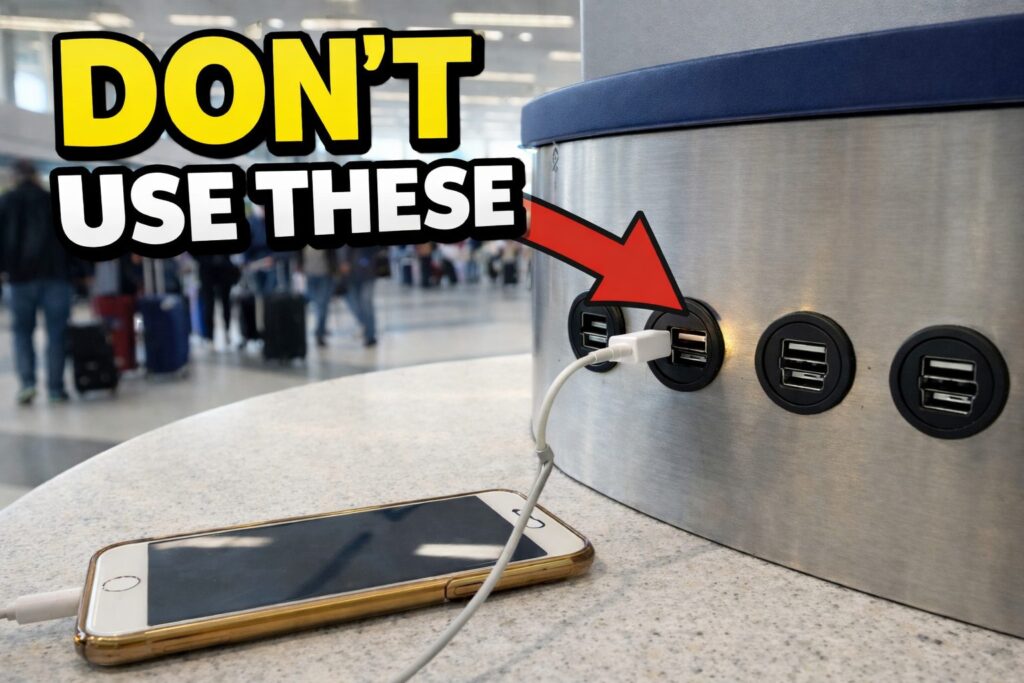
Dead phone anxiety hits different when you’re stuck at LAX with a 6-hour layover. Those USB ports scattered around the terminal beckon like digital sirens, promising salvation for your dying battery. But federal agencies want you to believe that convenience could cost you everything—your data, your privacy, maybe even your phone itself.
The Technical Boogeyman That Actually Works
Researchers have repeatedly demonstrated juice jacking’s theoretical effectiveness in controlled environments.
Brian Krebs coined “juice jacking” in 2011, describing how USB cables transfer both power and data simultaneously. Cybercriminals can theoretically exploit this duality through two attack vectors:
- Installing hidden chips in charging ports to steal passwords and photos within seconds
- Deploying “USB killer” devices that discharge massive voltage surges to permanently fry your phone’s circuitry
Georgia Tech researchers proved the concept at the 2013 BlackHat conference, creating malicious iPhone chargers for under $50. The technical mechanics check out perfectly—on paper and in controlled lab environments.
The Evidence Problem Nobody Talks About
Government warnings persist despite zero documented attacks on modern devices.
Here’s the plot twist worthy of a Christopher Nolan film: nobody can point to a single confirmed juice jacking incident on current iOS or Android devices. A 2023 Ars Technica investigation found “no documented cases” of public charging-station attacks, while Apple stated it was “unaware of any such attacks occurring in the wild.”
The FBI’s original warnings weren’t based on specific intelligence about actual incidents. Yet federal advisories keep recycling the same language year after year, creating a security theater that would make the TSA proud.
Airport Operators Take Phantom Threats Seriously
Major venues upgrade infrastructure to address theoretically possible attacks.
Detroit Metropolitan Airport now ensures all public charging stations are power-only and disconnected from data networks. The Port Authority managing JFK, Newark, and LaGuardia conducts regular tampering inspections.
These aren’t cheap upgrades—airport operators are spending real money to defend against a threat that exists primarily in research papers and government warnings.
Your Practical Defense Strategy
Simple precautions provide protection against both real and imaginary USB threats.
- Pack a portable battery or your own wall charger for peace of mind
- If you must use public ports, grab a USB data blocker for under $10
- Select “charge only” when your phone prompts for data connection permissions
- Power down your device before plugging in for maximum protection
These strategies defend against juice jacking while also protecting you from legitimate USB security risks that actually exist. Consider it insurance against both paranoia and the remote possibility that those government warnings might eventually prove prescient.
Last modified: December 30, 2025
About the Author: Chris Peters